
Why Mobility Support Is Central to Elderly Patient Care
When Malathi Govindarajan's 74-year-old father was discharged from hospital after a hip replacement in Coimbatore, the physiotherapy centre she chose for his recovery had one feature that immediately stood out: every piece of equipment was purpose-built for patient support, not improvised. The parallel bars were steady and correctly height-adjusted, the tilting table allowed the team to begin vertical loading within the first week, and the walking frame fitted her father's reach without modification. He was walking independently within nine weeks ahead of the timeline his orthopaedic surgeon had projected.
For elderly patients, mobility is not simply a clinical outcome it is the foundation of independence, dignity, and quality of life. The equipment supporting that mobility must be selected with the specific requirements of older patients in mind: wider load ranges, stable bases, intuitive adjustment mechanisms, and surfaces that accommodate reduced skin integrity and pressure sensitivity.
Mobility Aids That Matter Most for Elderly Patients
The range of mobility aids used in elderly rehabilitation covers both active treatment equipment and assistive devices that support day-to-day function. Prime Rehab Industries manufactures and supplies across both categories for hospitals, geriatric care units, and physiotherapy clinics throughout India.
Parallel Bars
Parallel bars are the starting point for gait rehabilitation in most elderly patients recovering from lower-limb surgery, fractures, or neurological events. They provide bilateral support that allows a patient to bear controlled weight through their legs while a therapist assesses stride length, foot placement, and trunk stability. For elderly patients with significant balance impairment, the bars provide the confidence to begin ambulation without fear of falling a psychological factor that is as important as the physical one. Prime Rehab Industries supplies both fixed-height and adjustable-height parallel bars, with stable base frames rated for clinical use.
Tilting Tables
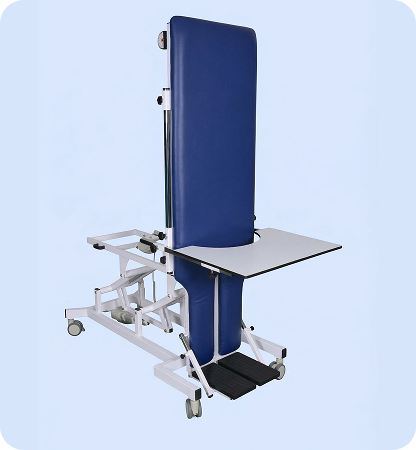
Extended bed rest is a common consequence of illness, surgery, or acute medical events in elderly patients. The physiological response orthostatic hypotension when moving from lying to standing can delay mobilisation significantly if not managed systematically. Tilting tables allow therapists to reintroduce gravitational stress gradually, monitoring blood pressure and tolerance at each angle increment. This controlled progression makes standing and walking safe far earlier than passive recovery allows. The high-low tilting table from Prime Rehab Industries combines adjustable-height positioning with precision tilt angle control, making it suitable for frail elderly patients as well as those with greater residual function.
Adjustable Physiotherapy Treatment Tables
For elderly patients receiving manual therapy, soft tissue treatment, or electrotherapy alongside their mobility rehabilitation, a treatment table that can be lowered close to floor level for safe transfer is essential. Fixed-height tables create transfer risk particularly for patients with hip precautions or reduced upper-limb strength. Prime Rehab Industries manufactures high-low treatment tables in two-fold and three-fold configurations, with electric height adjustment available for facilities treating high volumes of elderly patients.
Walking Frames and Assistive Devices
Walking frames including standard frames, wheeled variants, and rollators provide the transitional support that elderly patients need as they progress from parallel bar ambulation to independent walking. The right frame is matched to the patient's height, grip strength, weight-bearing status, and home environment. For clinics and hospitals sourcing these items alongside treatment equipment, Prime Rehab Industries can advise on appropriate specifications and supply both treatment and assistive mobility equipment through a single point of contact.
Key Considerations When Selecting Mobility Aids for Elderly Patients
Not all mobility aids perform equally in clinical environments. When specifying equipment for elderly rehabilitation in Indian hospitals and clinics, three factors consistently determine outcomes:
Load range and stability: Elderly patients span a wide weight range, and equipment must accommodate the full spectrum safely. Parallel bars and treatment tables with narrow load ratings or narrow base footprints create instability risk. Prime Rehab Industries specifies load ratings for all products and manufactures with wide-base frames designed for clinical use.
Ease of adjustment: In busy physiotherapy departments, therapists need to reconfigure equipment between patients quickly. Height adjustments that require tools, or that require significant force to operate, slow sessions and increase the risk of improvised positioning. Electric height adjustment on treatment tables and single-lever locking on parallel bars reduce session friction significantly.
Surface comfort for extended contact: Elderly patients have reduced skin integrity and are at greater risk of pressure injuries during prolonged contact with hard or poorly padded surfaces. Prime Rehab Industries uses high-density foam and clinical-grade rexine upholstery across its treatment table range, specified for extended patient contact in rehabilitation environments.
For a broader overview of how equipment quality affects recovery timelines in all age groups, see our post on how rehabilitation equipment helps faster patient recovery. For procurement guidance covering the full equipment range, our complete guide to rehabilitation equipment covers selection criteria in detail.
What Facilities and Families Say
"We run a geriatric rehabilitation unit in Chennai and our patient population is almost entirely elderly post-surgical and post-stroke cases. The parallel bars and tilting tables from Prime Rehab Industries have become the backbone of our mobility programme. The build quality is exactly what you need for this patient group solid, stable, and easy for our therapists to adjust between sessions."
— Sridhar Natarajasamy, Geriatric Care Coordinator, Chennai
"After my father's hip replacement, I was anxious about whether the physiotherapy equipment at his clinic would be safe enough for him. The tilting table they used was clearly professional-grade and the therapists were confident with it. That confidence transferred to my father he was far less hesitant about starting weight-bearing than I expected. He is now walking without any aids at home."
— Malathi Govindarajan, Daughter of Patient, Coimbatore
For information on sourcing rehabilitation equipment for your facility, see our guide to the best rehabilitation equipment suppliers in Chennai and our overview of top physiotherapy equipment for clinics and hospitals in India.
Frequently Asked Questions
What are the most important mobility aids for elderly patients at home?
For home use, the most important mobility aids for elderly patients are walking frames (standard or wheeled rollators depending on the patient's balance and endurance), grab rails in bathrooms and stairways, and non-slip bath and floor mats. For patients continuing physiotherapy at home after discharge, compact parallel bar units and portable traction equipment may be appropriate. A physiotherapist should assess the patient's home environment and recommend specific aids based on their mobility status and fall risk.
How do tilting tables help elderly patients in rehabilitation?
Tilting tables help elderly patients manage orthostatic hypotension the drop in blood pressure that occurs when moving from lying to standing after a period of bed rest. By gradually increasing the angle of tilt over multiple sessions, therapists allow the cardiovascular system to readjust to gravitational stress safely. This makes standing and walking possible earlier than bed-to-standing transfers would otherwise allow, and reduces the risk of falls or syncope during the mobilisation phase of recovery.
Are parallel bars suitable for elderly patients with severe balance problems?
Yes parallel bars are specifically designed for patients with significant balance impairment, including elderly patients with neurological conditions, severe deconditioning, or post-operative weight-bearing restrictions. The bilateral handrails provide firm, stable support at the correct height for the patient's arm length, allowing the therapist to focus on gait quality and weight distribution without the patient fearing a fall. For patients with very limited strength, parallel bar sessions can begin with minimal step distances and progress as tolerance improves.
How does Prime Rehab Industries support elderly care facilities across India?
Prime Rehab Industries manufactures and supplies a full range of rehabilitation and mobility equipment from Chennai, with distribution across Tamil Nadu and pan-India delivery. For elderly care facilities and geriatric rehabilitation units, the company can supply treatment tables, tilting tables, parallel bars, traction units, and assistive mobility devices all from a single supplier with local service support. Facilities can contact Prime Rehab Industries directly to discuss equipment specifications, quantities, and delivery timelines.
Equip Your Facility for Elderly Patient Care
Whether you are setting up a geriatric rehabilitation unit or upgrading an existing physiotherapy department serving elderly patients, Prime Rehab Industries supplies purpose-built mobility aids and rehabilitation equipment manufactured for the demands of clinical use.
Send an Enquiry | Call: +91 99943 51947 | View All Products
Email: primerehaboffl@gmail.com | WhatsApp: +91 99943 51947